The Clinical Research Facility is a dynamic and expanding department dedicated to advancing patient care through excellence in clinical research. The multidisciplinary team is led by the Head of Research, Dr Sadhbh O'Neill Scanlon, and Clinical Lead, Prof. Patrick Mitchell, and includes Clinical Nurse Manager and Clinical Trial Coordinator, Saoirse Collins; Contracts Officer, Deirdre O'Brien; and Research Assistant, Caoimhe Murphy.
The CRF works closely with key hospital departments, including the Cancer Clinical Trials Office, Radiology, Pharmacy, and the Meath Laboratory, to ensure the seamless delivery of research studies from start-up to completion. This integrated approach supports efficient study conduct, timely sample processing, and consistently high standards of patient care.
As a research-active facility, we are committed to providing a supportive environment for investigators, sponsors, and participants. We deliver clinical trials to the highest standards of quality, safety, and regulatory compliance, adhering to the principles of Good Clinical Practice and maintaining a strong focus on participant experience.
Our growing research portfolio reflects our commitment to innovation, collaboration, and the generation of evidence that improves outcomes for patients and contributes to the advancement of healthcare.
CONTACT DETAILS:
Saoirse.Collins@tuh.ie, 087 220 2614, Deirdre.obrien@tuh.ie or Sadhbh.oneill@tuh.ie
Information for Sponsors
- The TUH CRF employs a structured governance framework to facilitate an efficient and responsive feasibility assessment process. During the feasibility stage of a clinical trial, application forms are completed and submitted to the relevant healthcare departments required for trial delivery, including Pharmacy, Radiology, and Laboratory Services.
- Should any issues arise during this process, every effort is made to support the relevant department in addressing challenges associated with trial delivery. The CRF works collaboratively with all stakeholders to identify practical solutions and ensure that trial activities can be conducted effectively. As a busy academic hospital, TUH is committed to overcoming the day-to-day challenges associated with clinical research and maintaining a supportive environment for trial conduct.
- TUH is strongly committed to expanding its clinical research portfolio and has established the growth of clinical trial activity as a key strategic objective for the organisation.
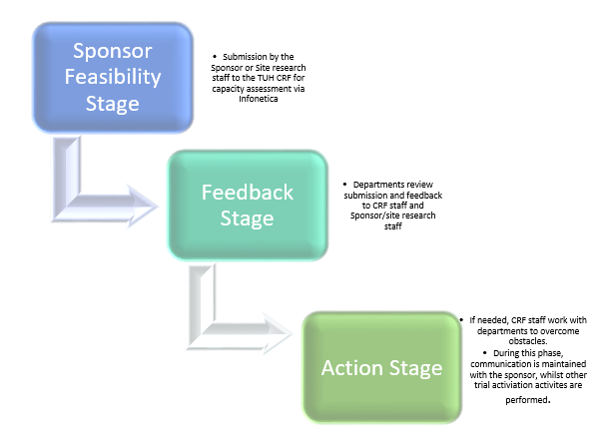
During the site feasibility stage of a clinical trial, the Research Office/CRF uses Infonetica to manage and communicate the feasibility assessment process. Applicants must provide study details and then select the resources required for their study. The most commonly requested resources are Pharmacy, Radiology, and the Meath Laboratory. If additional resources are required, applicants outline these additional resources in the assessment form and the CRF CNMII will liaise with that department to assess capacity.
Pharmacy capacity assessment is the first step in the process, where applicants complete a Clinical Trial Feasibility Form and provide details of the investigational medicinal product (IMP), storage requirements, expected stock levels, and relevant pharmacy manuals. The Pharmacy Clinical Trials Team reviews the application and may request further information through Infonetica. The Pharmacy Clinical Trials Team will notify the applicant is capacity is confirmed or liaise directly with the Research Office/CNMII if capacity is not available at this time.
The application then progresses to Radiology (where required), followed by the Meath Foundation Laboratory. Each department reviews the study requirements and may request additional information via Infonetica. Confirmation of capacity are sent at each stage and a final letter of TUH capacity is sent at the end of the process.
Throughout the process, Infonetica acts as the central platform for applications, departmental reviews, and communication between applicants and the relevant teams